
8.8 vs 12.9 Grades
Difference Between 8.8 & 12.9 Grades
5/12/20253 min read
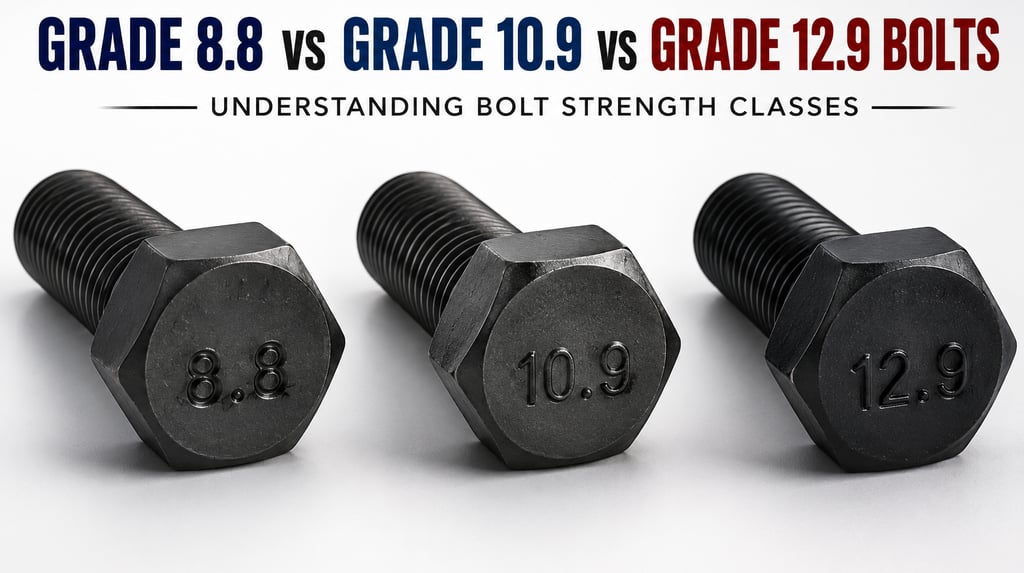
Grade 8.8 vs Grade 10.9 vs Grade 12.9 Bolts: Understanding Bolt Strength Classes
Introduction
Selecting the correct bolt grade is critical for ensuring safety, reliability, and long-term performance in engineering and construction applications. Among the most commonly used high tensile fasteners are Grade 8.8, Grade 10.9, and Grade 12.9 bolts. Each grade offers different mechanical properties and is designed for specific load-bearing requirements.
Whether used in steel structures, industrial machinery, heavy engineering equipment, infrastructure projects, or manufacturing plants, understanding the differences between these bolt grades helps engineers and procurement professionals make informed decisions.
This guide explains the characteristics, applications, advantages, and selection criteria for Grade 8.8, 10.9, and 12.9 high tensile bolts.
What Do Bolt Grades Mean?
Bolt grades indicate the mechanical properties of a fastener, including tensile strength and yield strength.
The property class system used in metric fasteners is defined according to international standards such as ISO 898-1.
The first number represents the nominal tensile strength.
The second number indicates the ratio of yield strength to tensile strength.
Higher numbers generally indicate stronger fasteners capable of handling greater loads.
Grade 8.8 Bolts
Grade 8.8 bolts are among the most widely used high tensile fasteners in industrial and construction applications.
Mechanical Properties
Tensile Strength: 800 MPa
Yield Strength: 640 MPa
Applications
Grade 8.8 bolts are commonly used in:
Structural steel fabrication
Commercial buildings
Construction equipment
Manufacturing machinery
Industrial assemblies
Material handling systems
Advantages
Cost-effective solution
Good strength-to-cost ratio
Suitable for most industrial applications
Readily available worldwide
Grade 10.9 Bolts
Grade 10.9 bolts provide significantly higher strength than Grade 8.8 fasteners and are widely used in demanding industrial applications.
Mechanical Properties
Tensile Strength: 1000 MPa
Yield Strength: 900 MPa
Applications
Grade 10.9 bolts are commonly used in:
Heavy engineering equipment
Mining machinery
Cranes
Power generation systems
Industrial processing plants
Steel structures requiring higher load capacity
Advantages
Higher load-bearing capacity
Excellent fatigue resistance
Improved performance under dynamic loads
Suitable for critical applications
Grade 12.9 Bolts
Grade 12.9 bolts represent one of the highest-strength classes available for industrial fasteners.
Mechanical Properties
Tensile Strength: 1200 MPa
Yield Strength: 1080 MPa
Applications
Grade 12.9 fasteners are typically used in:
High-performance machinery
Precision engineering equipment
Heavy-duty industrial systems
Automotive performance applications
Specialized engineering projects
Advantages
Extremely high strength
Superior resistance to deformation
Excellent performance under extreme loads
Reliable in critical engineering applications
Comparison Table
PropertyGrade 8.8Grade 10.9Grade 12.9Tensile Strength800 MPa1000 MPa1200 MPaYield Strength640 MPa900 MPa1080 MPaCommon UseConstructionHeavy EngineeringCritical ApplicationsCostModerateHigherHighestLoad CapacityGoodVery HighExtremely High
How Are High Tensile Bolts Manufactured?
The manufacturing process of Grade 8.8, 10.9, and 12.9 bolts typically includes:
Raw Material Selection
High-quality carbon steel or alloy steel is selected based on the required mechanical properties.
Forging
Bolt heads are formed using precision cold forging or hot forging processes.
Thread Rolling
Threads are rolled to improve strength and fatigue resistance.
Heat Treatment
Heat treatment involves:
Hardening
Quenching
Tempering
This process significantly improves strength, hardness, and durability.
Quality Inspection
Every batch undergoes rigorous testing for:
Tensile strength
Hardness
Dimensional accuracy
Thread quality
Material composition
Choosing the Right Bolt Grade
The correct bolt grade depends on several factors.
Load Requirements
Higher loads generally require Grade 10.9 or Grade 12.9 fasteners.
Safety Requirements
Critical applications should use bolts with sufficient safety margins.
Environmental Conditions
Corrosion resistance requirements may influence material and coating selection.
Industry Standards
Many projects specify particular bolt grades based on engineering standards.
Industries Using High Tensile Bolts
Construction Industry
Steel structures
Commercial buildings
Industrial sheds
Infrastructure projects
Energy Sector
Solar power plants
Wind turbine installations
Power transmission systems
Heavy Engineering
Industrial machinery
Mining equipment
Material handling systems
Manufacturing
Production equipment
Process plants
Automation systems
Frequently Asked Questions
Which bolt grade is stronger, 8.8 or 10.9?
Grade 10.9 bolts provide significantly higher tensile and yield strength than Grade 8.8 bolts.
Is Grade 12.9 always the best choice?
Not necessarily. The best choice depends on application requirements, design loads, and engineering specifications.
Can Grade 10.9 bolts replace Grade 8.8 bolts?
In many applications they can, but engineers should verify design requirements and compatibility before making substitutions.
Which industries commonly use Grade 12.9 bolts?
Heavy engineering, precision machinery, automotive, and critical industrial applications frequently use Grade 12.9 fasteners.
Conclusion
Understanding the differences between Grade 8.8, Grade 10.9, and Grade 12.9 bolts is essential for selecting the correct fastening solution. Each grade offers unique advantages depending on strength requirements, application conditions, and project specifications.
By choosing high-quality fasteners manufactured according to international standards, engineers and buyers can ensure safety, reliability, and long-term performance in construction, infrastructure, and industrial applications worldwide.
UNIT 1
Plot No 19, Mangarh, Kohara, Macchiwara Road, Ludhiana (Punjab) - 141112
Domestic & International Sales
+91 93576 36660
+91 98882 01495
UNIT 2
Plot No 41, Mangarh, Kohara, Macchiwara Road, Ludhiana (Punjab) - 141112