
Guide to High Tensile Bolts
Guide to High Tensile Bolts
6/12/20253 min read
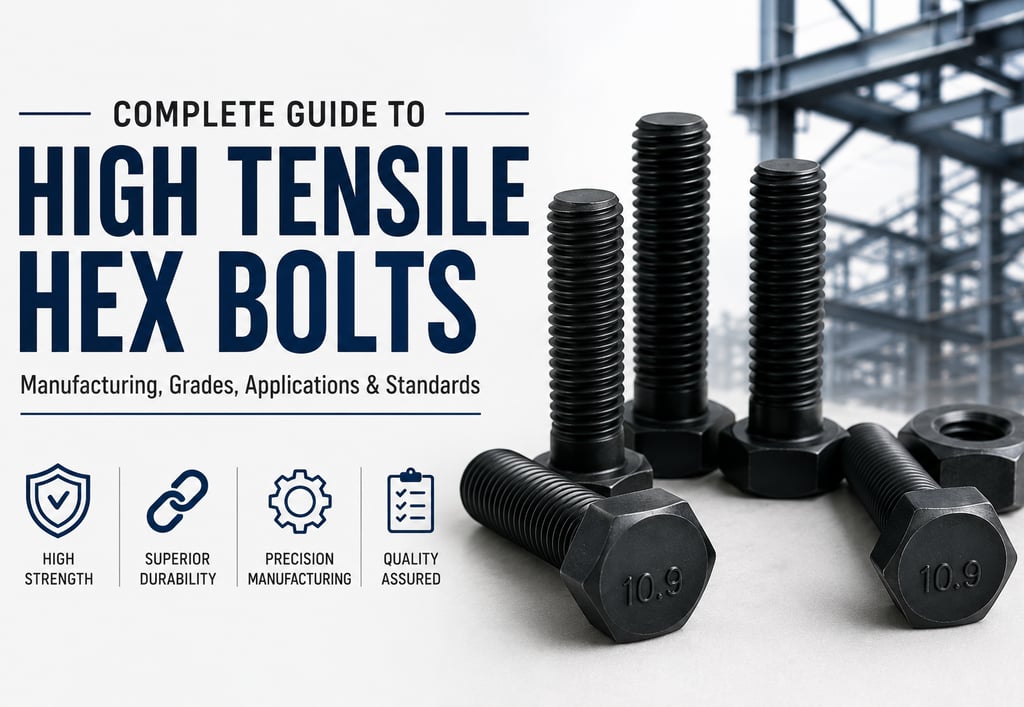
Complete Guide to High Tensile Hex Bolts: Manufacturing, Grades, Applications & Standards
Introduction
High tensile hex bolts are among the most widely used industrial fasteners in modern engineering, construction, infrastructure, power generation, oil & gas, steel fabrication, and heavy machinery industries. Designed to withstand high loads and demanding operating conditions, these high-strength fasteners provide secure and reliable fastening solutions for critical applications.
As a leading fastener manufacturer, understanding the manufacturing process, material grades, international standards, and applications of high tensile hex bolts is essential for engineers, procurement professionals, project managers, and industrial buyers.
This comprehensive guide explains everything you need to know about high tensile bolts, including manufacturing methods, bolt grades, standards, applications, and quality control procedures.
What Are High Tensile Hex Bolts?
A high tensile hex bolt is a threaded fastener manufactured from medium carbon steel or alloy steel and heat-treated to achieve high strength and durability.
The hexagonal head design allows easy installation and removal using standard tools such as spanners and torque wrenches.
High tensile bolts are commonly available in property classes such as:
Grade 8.8
Grade 10.9
Grade 12.9
These grades indicate the mechanical properties and tensile strength of the bolt.
Compared to standard mild steel bolts, high tensile fasteners offer:
Higher tensile strength
Better fatigue resistance
Improved load-bearing capacity
Superior performance under dynamic loads
Enhanced durability in demanding environments
Manufacturing Process of High Tensile Hex Bolts
The manufacturing of industrial fasteners involves several precision-controlled processes to ensure dimensional accuracy and mechanical performance.
1. Raw Material Selection
The process begins with selecting high-quality steel wire rods or alloy steel materials.
Common materials include:
Carbon Steel
Medium Carbon Steel
Alloy Steel
Boron Steel
The quality of raw material significantly affects the final strength and performance of the fastener.
2. Wire Drawing
Steel wire rods are drawn through dies to achieve the required diameter and improve material consistency.
Benefits include:
Improved surface finish
Enhanced dimensional accuracy
Better mechanical properties
3. Heading and Forging
The bolt head is formed using cold forging or hot forging techniques.
Cold forging offers:
High production efficiency
Excellent dimensional precision
Better material utilization
For larger diameter bolts, hot forging may be preferred.
4. Thread Rolling
Threads are formed through thread rolling rather than cutting.
Advantages of thread rolling include:
Increased thread strength
Better fatigue resistance
Improved surface finish
Longer service life
5. Heat Treatment
Heat treatment is a critical stage in manufacturing high tensile bolts.
The process typically involves:
Hardening
Quenching
Tempering
Heat treatment improves:
Tensile strength
Yield strength
Hardness
Wear resistance
6. Surface Finishing
Depending on application requirements, bolts may receive various protective coatings:
Zinc Plating
Hot Dip Galvanizing
Mechanical Galvanizing
Black Oxide
Phosphate Coating
Dacromet Coating
These coatings help improve corrosion resistance and service life.
High Tensile Bolt Grades Explained
Grade 8.8 Bolts
Grade 8.8 bolts are widely used in:
Steel structures
Industrial machinery
Construction projects
Automotive assemblies
Key characteristics:
Tensile Strength: 800 MPa
Yield Strength: 640 MPa
Grade 10.9 Bolts
Grade 10.9 fasteners are used in applications requiring higher strength.
Typical industries include:
Heavy engineering
Mining equipment
Infrastructure projects
Industrial machinery
Key characteristics:
Tensile Strength: 1000 MPa
Yield Strength: 900 MPa
Grade 12.9 Bolts
Grade 12.9 bolts provide exceptional strength for critical applications.
Common uses include:
High-performance machinery
Industrial equipment
Specialized engineering applications
Key characteristics:
Tensile Strength: 1200 MPa
Yield Strength: 1080 MPa
International Fastener Standards
Industrial fasteners are manufactured according to globally recognized standards.
ISO Standards
Popular ISO standards include:
ISO 4014
ISO 4017
ISO 898-1
DIN Standards
Common DIN standards include:
DIN 931
DIN 933
DIN 960
DIN 961
ASTM Standards
Widely used ASTM standards include:
ASTM A325
ASTM A490
ASTM F3125
Compliance with international standards ensures quality, interchangeability, and global acceptance.
Applications of High Tensile Hex Bolts
High tensile bolts are used across numerous industries.
Construction Industry
Applications include:
Structural steel buildings
Bridges
Commercial complexes
Industrial sheds
Infrastructure Projects
Used in:
Metro rail systems
Airports
Highways
Power plants
Oil & Gas Industry
Critical applications include:
Pipelines
Refineries
Offshore platforms
Processing facilities
Renewable Energy
Used in:
Solar mounting structures
Wind turbine assemblies
Power transmission systems
Heavy Engineering
Applications include:
Cranes
Earthmoving equipment
Mining machinery
Manufacturing plants
Quality Control in Fastener Manufacturing
Reliable fastener manufacturers implement stringent quality control procedures.
Typical tests include:
Tensile Testing
Verifies the load-bearing capacity of the fastener.
Hardness Testing
Measures material hardness after heat treatment.
Dimensional Inspection
Ensures compliance with specified tolerances.
Thread Inspection
Checks thread profile, pitch, and fit.
Coating Thickness Testing
Verifies corrosion protection performance.
Chemical Composition Analysis
Confirms material conformity with specifications.
Advantages of High Tensile Hex Bolts
Key benefits include:
Exceptional strength
Reliable performance
Long service life
High load-bearing capability
Resistance to vibration
Compatibility with international standards
Suitable for demanding industrial applications
These characteristics make high tensile hex bolts one of the most trusted fastening solutions for critical engineering projects worldwide.
Frequently Asked Questions
What is the difference between Grade 8.8 and Grade 10.9 bolts?
Grade 10.9 bolts offer significantly higher tensile and yield strength compared to Grade 8.8 bolts, making them suitable for more demanding applications.
Are high tensile bolts suitable for structural applications?
Yes. High tensile structural bolts are extensively used in bridges, buildings, steel structures, and infrastructure projects.
Which standards are commonly used for hex bolts?
ISO, DIN, ASTM, and BS standards are among the most widely used international fastener standards.
What industries use high tensile fasteners?
Construction, infrastructure, oil & gas, power generation, mining, renewable energy, heavy engineering, and manufacturing industries all rely on high tensile fasteners.
Conclusion
High tensile hex bolts play a critical role in modern engineering and industrial applications. Their superior strength, durability, and reliability make them essential components in construction, infrastructure, heavy machinery, power generation, and industrial manufacturing projects.
By understanding bolt grades, manufacturing processes, international standards, and quality control requirements, buyers and engineers can select the right fastening solution for their specific applications. Choosing a trusted fastener manufacturer ensures consistent quality, compliance with international standards, and dependable performance across every project.
UNIT 1
Plot No 19, Mangarh, Kohara, Macchiwara Road, Ludhiana (Punjab) - 141112
Domestic & International Sales
+91 93576 36660
+91 98882 01495
UNIT 2
Plot No 41, Mangarh, Kohara, Macchiwara Road, Ludhiana (Punjab) - 141112